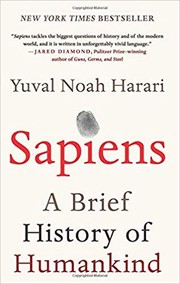
💡 Expert Order Guide: Epoch Reading Sequence: Read chronologically through the 4 major transformations that shaped our species: Cognitive (70,000 years ago), Agricultural (12,000 years ago), Unification, and the Scientific Revolution (500 years ago to today).
Why Homo sapiens replaced Neanderthals and all other human species: the evolutionary miracle of believing in things that don't physically exist.
⚡ Full Plot Refresher & Ending Recap (The Cognitive Revolution: The Fiction Factor)
- 100,000 years ago, there were at least 6 distinct human species walking the Earth (Homo sapiens, Neanderthals, Denisovans, Homo floresiensis, etc.). Sapiens were middle-tier foragers in East Africa.
- The Cognitive Revolution (around 70,000 years ago) mutated our brain circuitry, enabling complex vocal language capable of gossip, trade, and storytelling.
- The secret superpower: Imagined Orders. Chimpanzee troops cannot exceed ~150 individuals due to physical social grooming limits. Sapiens can cooperate by the millions because we invent and believe in shared fictions: gods, nations, laws, and corporations (like Peugeot).
- Colonization of Australia and the Americas triggered the rapid extinction of 70%+ of the world's megafauna (mammoths, giant ground sloths) long before the invention of the wheel.
🎯 Key Setup for Next Entry: Before Epoch 2: Reflect on how money, human rights, and corporations are shared fictions that govern our physical lives.
Epoch 2 • Mind-Bending History
2. The Agricultural Revolution: History's Biggest Trap (2014)
Length / Scope: Part 2 (85 pp)
🛡️ Open in Interactive Tracker
Why the shift from nomadic hunting to wheat farming gave humanity more food, but individual humans a harsher diet, more diseases, and backbreaking labor.
⚡ Full Plot Refresher & Ending Recap (The Agricultural Revolution: History's Biggest Trap)
- Around 10,000 BCE, humans began domesticating wheat, rice, and barley. Harari argues that wheat domesticated humans rather than the reverse.
- Foragers enjoyed varied diets, shorter workdays, and less disease. Farmers worked dawn to dusk, suffered spine deformation, lived near animal feces, and were vulnerable to catastrophic famines.
- The luxury trap: once population exploded due to farming, humanity could never return to nomadic foraging. More food created more people, locking us into permanent settlements.
- The birth of permanent anxiety about the future (weather, taxes, storage) and the earliest bureaucratic written records—which were not poetry or philosophy, but grain accounting ledgers in Mesopotamia.
🎯 Key Setup for Next Entry: Before Epoch 3: Consider how modern tech conveniences often become compulsory traps we can no longer abandon.
Epoch 3 • Global Anthropology
3. The Unification of Humankind: Money, Empires & Religion (2014)
Length / Scope: Part 3 (95 pp)
🛡️ Open in Interactive Tracker
The 3 universal forces that gradually knitted disparate human tribes into a single global interconnected civilization.
⚡ Full Plot Refresher & Ending Recap (The Unification of Humankind: Money, Empires & Religion)
- Universal Unifier #1: Money. The most universal and efficient system of mutual trust ever devised—gold, silver, and digital fiat allow even bitter enemies to cooperate effortlessly.
- Universal Unifier #2: Empires. While violent and imperialist, multi-ethnic empires blended customs, languages, and technologies into cohesive shared identities.
- Universal Unifier #3: Universal Religions. The shift from animism (every tree has a spirit) to polytheism, and finally to monotheism and dualism, providing legitimacy to social orders across continents.
🎯 Key Setup for Next Entry: Before Epoch 4: Notice how a US Dollar bill is universally accepted anywhere on Earth regardless of politics or faith.
The explosive admission of 'We Do Not Know' that ignited modern science, global capitalism, and the imminent dawn of cyborgs and AI.
⚡ Full Plot Refresher & Ending Recap (The Scientific Revolution & The Future of Sapiens)
- The revolutionary premise of modern science (starting around 1500 CE): earlier traditions claimed all important truths were already revealed in holy texts. Modern science began with the admission of ignorance.
- The marriage of Science, Empire, and Capitalism: banks loan money based on trust in the future, creating credit-fueled technological acceleration.
- The Industrial Revolution replaced human and animal muscle with coal, steam, and electricity, liberating humanity from natural season cycles but breaking down family networks in favor of states and markets.
- The End of Sapiens: intelligent design is replacing natural selection via genetic engineering, direct brain-computer neural links, and artificial intelligence.
🎯 Key Setup for Next Entry: Mastery: Humankind has acquired god-like powers—our greatest challenge is choosing what we truly want to become.
👥 Core Character Guide
Yuval Noah Harari
Historian, Philosopher & Oxford PhD
Professor at the Hebrew University of Jerusalem whose panoramic big-history books have sold over 45 million copies in 65 languages.
Homo Neanderthalensis
Robust Cousin Species of Sapiens
Adapted to ice-age Europe with larger brains and muscular frames; interbred with Sapiens before disappearing ~40,000 years ago.
🎮📖🖖 Similar Books, Sci-Fi & Games
📖 Book / Sci-Fi Match
Guns, Germs, and Steel
by Jared Diamond
The Pulitzer-winning masterpiece on how geography, continental axes, and domesticable native plants shaped Eurasian dominance.
🎮 Video Game Match
Sid Meier's Civilization VI
by Firaxis Games
The quintessential interactive embodiment of Sapiens: guide a stone-age tribe through the 4 revolutions, building shared myths, world wonders, and nuclear deterrence.