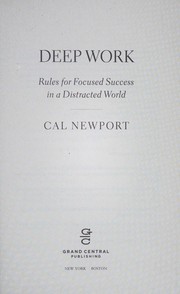
💡 Expert Order Guide: Execution Sequence: Read Part 1 to understand why deep focus is economically valuable and psychologically fulfilling. Then execute Rule 1 (choose your deep work scheduling philosophy) and Rule 4 (implement a strict end-of-day shutdown ritual).
The Idea • Mandatory Theory
1. The Case for Deep Work: Rare, High-Value & Fulfilling (2016)
Length / Scope: Part 1 (90 pp)
🛡️ Open in Interactive Tracker
Why high-skilled modern workers are trapped in frantic busyness (shallow work) and how true focus produces 10x higher quality results in half the time.
⚡ Full Plot Refresher & Ending Recap (The Case for Deep Work: Rare, High-Value & Fulfilling)
- Defines Deep Work: Professional activities performed in a state of distraction-free concentration that push cognitive capabilities to their limit, creating new value and making skills hard to replicate.
- Defines Shallow Work: Non-cognitively demanding, logistical tasks (email, chat pings, formatting) often performed while distracted that create little new value.
- The Deep Work Hypothesis: The ability to perform deep work is becoming increasingly rare at the exact same time it is becoming increasingly valuable in our digital economy.
- Attention Residue: When you switch from Task A to Task B (even just glancing at an inbox for 2 seconds), a residue of your attention remains stuck on Task A, severely degrading mental performance for up to 20 minutes.
🎯 Key Setup for Next Entry: Before Rule 1: Notice how often you toggle tabs or check phones while trying to write or analyze complex problems.
Rule #1 • Core Scheduling Strategy
2. Work Deeply: Philosophies, Rituals & The 4DX Framework (2016)
Length / Scope: Chapters 1–2 (55 pp)
🛡️ Open in Interactive Tracker
Pick your deep work philosophy: Monastic, Bimodal, Rhythmic, or Journalistic, and build bulletproof rituals around location and start times.
⚡ Full Plot Refresher & Ending Recap (Work Deeply: Philosophies, Rituals & The 4DX Framework)
- Willpower is a finite resource; hoping to 'find time' for deep work fails every time. You must ritualize when, where, and how you work.
- Four Scheduling Philosophies: Monastic (Carl Jung, isolating in a cabin for months); Bimodal (dividing weeks into deep focus vs administrative chunks); Rhythmic (chaining 90-minute morning deep blocks daily); Journalistic (switching into deep mode whenever free time appears).
- The 4 Disciplines of Execution (4DX): Focus on the Wildly Important, Act on Lead Measures (hours spent in deep work), Keep a Compelling Scoreboard, and Create a Cadence of Accountability.
🎯 Key Setup for Next Entry: Before Rule 2: Commit to a 90-minute uninterrupted deep work block tomorrow morning before opening your email.
Rule #2 • Mental Conditioning
3. Embrace Boredom: Rewiring Your Distraction Addiction (2016)
Length / Scope: Chapter 3 (40 pp)
🛡️ Open in Interactive Tracker
If every solitary second in line or at a red light you grab your smartphone, you've permanently trained your brain to crave constant low-grade stimulation.
⚡ Full Plot Refresher & Ending Recap (Embrace Boredom: Rewiring Your Distraction Addiction)
- The ability to concentrate deeply is a skill that must be trained, not just a switch you flip.
- Schedule your internet blocks: instead of scheduling breaks from distraction, schedule your distraction into narrow, designated internet windows.
- Productive Meditation: pick a professional problem and hold your attention on it while taking a walk, cycling, or doing dishes, gently returning your mind when it wanders.
🎯 Key Setup for Next Entry: Before Rule 3: Wait in your next line or elevator with your phone left untouched in your pocket.
Rule #3 • Tool Selection
4. Quit Social Media: The Craftsman Approach to Digital Tools (2016)
Length / Scope: Chapter 4 (45 pp)
🛡️ Open in Interactive Tracker
Reject the 'Any-Benefit' mindset and adopt the Craftsman Approach: a tool is only worth using if its positive impact substantially outweighs its drag on your focus.
⚡ Full Plot Refresher & Ending Recap (Quit Social Media: The Craftsman Approach to Digital Tools)
- The Any-Benefit Fallacy: believing that if a digital tool offers ANY minuscule benefit (e.g. keeping up with an old acquaintance), it justified having open notifications all day.
- The Craftsman Approach to Tool Selection: identify the core goals of your professional and personal life, and only adopt a tool if it directly supports those goals.
- Don't use the internet for low-effort entertainment: plan your leisure time deliberately (reading books, making things, exercising) so you don't default to passive algorithmic feeds.
🎯 Key Setup for Next Entry: Before Rule 4: Conduct a 30-day social media fast or delete the app icons from your primary phone screen.
Rule #4 • Daily Work Protection
5. Drain the Shallows: Fixed-Schedule Productivity & Shutdowns (2016)
Length / Scope: Chapter 5 (50 pp)
🛡️ Open in Interactive Tracker
How to cap your work day, schedule every minute of your day with time blocks, and execute a strict end-of-day shutdown ritual.
⚡ Full Plot Refresher & Ending Recap (Drain the Shallows: Fixed-Schedule Productivity & Shutdowns)
- Time-Block Planning: plan every hour of your workday in blocks, giving every minute a job (and adjusting flexibly when emergencies happen).
- Quantify the depth of every activity: ask yourself 'How many months would it take a smart college graduate with no specialized training to do this task?'
- Fixed-Schedule Productivity: set a hard stop time for work (e.g. 5:30 PM) and work backward to ruthlessly cull low-value meetings and fluff.
- The Shutdown Ritual: review tomorrow's tasks, close all open browser tabs, say a closing phrase ('Shutdown complete'), and forbid yourself from checking work emails until morning.
🎯 Key Setup for Next Entry: Mastery: Execute your first full daily shutdown ritual tonight and allow your mind to fully recharge.
👥 Core Character Guide
Cal Newport
Computer Science Professor at Georgetown & Author
Theoretical computer scientist and author who famously has never held a social media account while publishing groundbreaking papers and national bestsellers.
Carl Jung
Pioneer of Analytical Psychology
Built the stone Bollingen Tower on Lake Zurich to retreat into distraction-free monastic solitude and develop revolutionary psychoanalytic theories.
🎮📖🖖 Similar Books, Sci-Fi & Games
📖 Book / Sci-Fi Match
Limitless
by Jim Kwik
Jim Kwik gives you the rapid cognitive memory and reading gears; Cal Newport protects the high-intensity distraction-free hours needed to use them.
🎮 Video Game Match
Subnautica / Satisfactory
by Unknown Worlds / Coffee Stain
Games that reward deep, uninterrupted flow state and methodical architectural planning without twitch reflex interruptions.